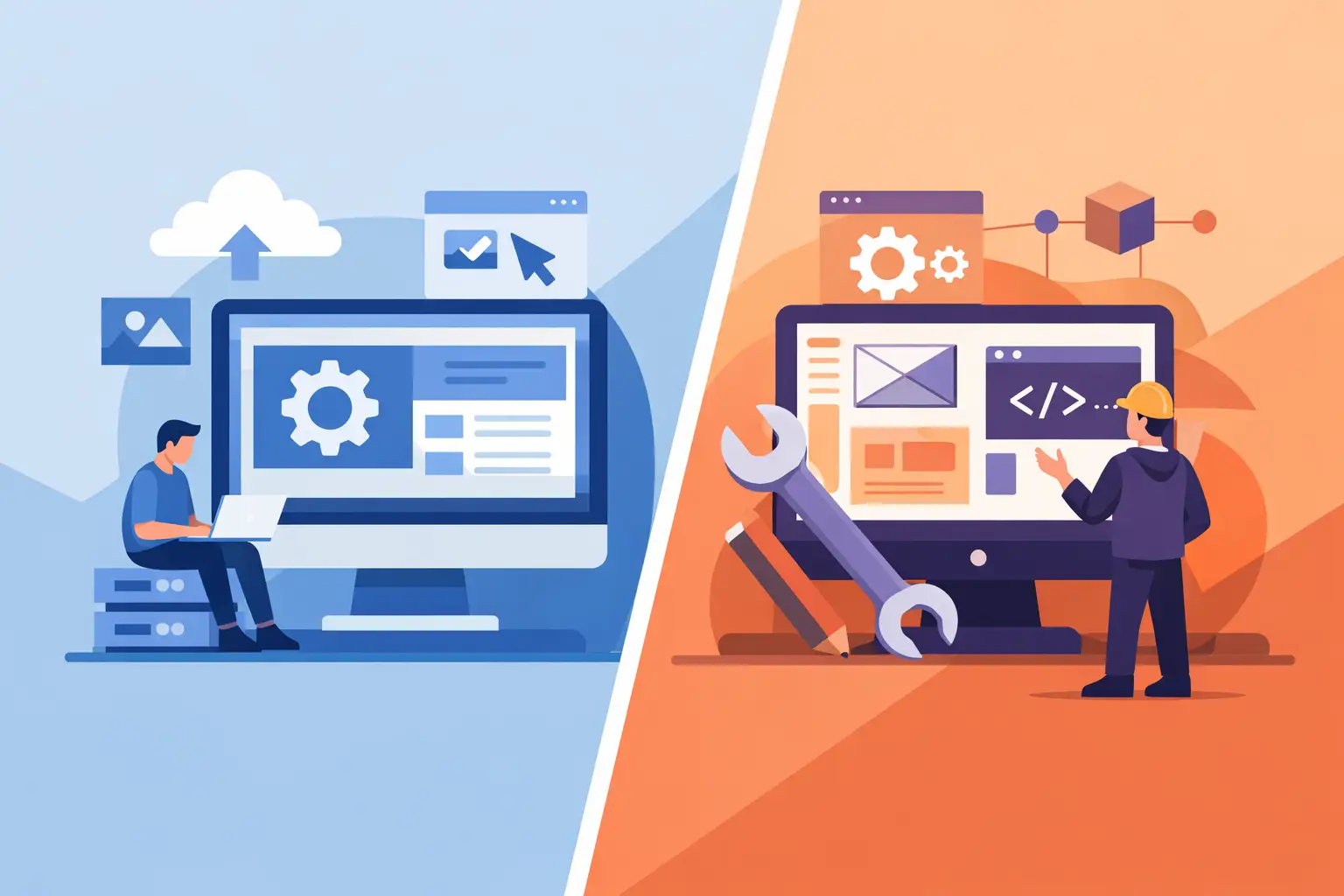
If you are weighing up a wordpress vs custom website build decision, you are probably not looking for a lecture on code. You want to know which option will help your business look credible, get found online, and turn visitors into enquiries without creating a maintenance headache six months down the line.
For startups and small businesses, this choice is rarely about what is technically possible. Both routes can produce a strong website. The real question is which one fits your goals, budget, timeline, and how much hands-on support you want after launch.
WordPress vs custom website build - what is the actual difference?
WordPress is a content management system. In plain English, it is a widely used platform that allows websites to be built and managed without starting from scratch every time. It can be adapted with themes, plugins, and bespoke development, which is why it powers everything from simple brochure sites to larger business websites.
A custom website build is exactly what it sounds like. The site is designed and developed around your specification rather than being shaped around an existing platform theme or plugin setup. That does not automatically mean it is better. It means it is more tailored.
This distinction matters because many business owners assume WordPress means cheap template and custom means expensive luxury. In reality, there is a middle ground. A well-built WordPress site can still be tailored, and a custom build should only be chosen when the extra flexibility solves a real business need.
When WordPress makes the most sense
For many small businesses, WordPress is the practical choice. If you need a professional website launched in a sensible timeframe, with the ability to edit pages, add blog posts, update services and keep things moving without calling a developer for every small change, WordPress can do that very well.
It is especially suited to businesses that need standard website features such as service pages, contact forms, galleries, blogs, location pages, and basic search engine visibility. A local trades business, consultant, startup, therapist, or agency often does not need a fully custom software-style build. They need a site that looks professional, works properly, and is easy to manage.
The strongest case for WordPress is efficiency. You are not reinventing the wheel. That can reduce build time and cost while still allowing plenty of room for branded design, content structure, and lead generation features.
That said, the quality varies wildly. A rushed WordPress site packed with bloated plugins and a generic theme can become slow, awkward to update, and frustrating to live with. The platform is not the issue there. The build approach is.
When a custom website build is worth it
A custom website build starts to make more sense when your business has requirements that do not fit neatly into an off-the-shelf setup. That might mean a unique customer journey, specialist functionality, complex integrations, or a need for tighter control over performance and user experience.
If your website is central to how your business operates, rather than simply how it presents itself, custom often earns its place. The more your site needs to do beyond showcasing your business, the more likely it is that a custom solution will save compromises later.
There is also a branding angle. Some businesses want a website that feels completely distinct from competitors using the same design patterns and layouts. A custom build gives more freedom to shape every part of the experience around your brand, your audience, and your conversion goals.
The trade-off is straightforward. Custom builds usually take longer, require a clearer specification, and involve a higher initial investment. That is sensible if the result supports growth and removes limitations. It is less sensible if your actual need is a polished, reliable business website with straightforward functionality.
Cost is not just the build price
This is where the wordpress vs custom website build debate often gets oversimplified. People compare the upfront figure and stop there. That can be expensive in the long run.
WordPress is often more affordable to launch, particularly for small businesses that need core functionality rather than something highly specialised. But ongoing costs still matter. Hosting, updates, plugin licensing, security checks, content changes, and general support all need to be accounted for. A cheaper build can become a false economy if it is difficult to maintain or keeps breaking.
Custom websites usually carry a higher starting cost because more is being planned and built around your exact needs. But if that build avoids unnecessary tools, reduces technical debt, and gives you a cleaner long-term setup, it may prove better value over time.
The right question is not just, "Which one costs less?" It is, "Which one gives my business the most useful result without paying for complexity I do not need?"
Speed to launch versus long-term flexibility
If you need to get online quickly, WordPress often has the advantage. A structured build process can move from planning to launch faster because the foundation is already there. For startups trying to establish credibility or service businesses that simply need a modern online presence, that speed can be a real business advantage.
Custom development usually takes longer because more decisions are being made from the ground up. That extra time is worthwhile when the outcome needs to be highly specific, but it is not always necessary.
This is where honest advice matters. Some providers push custom because it sounds premium. Others push WordPress because it is quicker to sell. Neither route is right by default. The best option is the one that fits the current stage of your business while leaving room to grow.
Ease of use matters more than most people expect
Many small business owners do not want to become website managers. They want to update a phone number, post a news item, add a new service and get on with running the business.
WordPress can be very user-friendly when built properly. Content areas can be structured clearly, and routine updates can be kept simple. But if the back end is cluttered with unnecessary options and plugin menus, it quickly becomes confusing.
A custom site can also be easy to use, but only if usability has been planned properly. Bespoke does not automatically mean simpler. Sometimes it means the opposite if too much has been built without thinking about day-to-day management.
For most smaller firms, ease of use should be part of the brief from day one. A good website should not only look professional to your visitors. It should also feel manageable to your team.
SEO and performance are not platform guarantees
Some business owners ask whether WordPress is better for SEO or whether custom websites rank better. The truth is less exciting but more useful. Good rankings come from sound structure, fast performance, relevant content, local signals, and a site that supports a strong user experience.
WordPress can perform very well for SEO when the site is built carefully. Custom websites can also perform very well. Neither option automatically puts you at the top of Google.
The same goes for speed. A lean custom website may outperform a poorly built WordPress one. A well-optimised WordPress site may outperform an over-engineered custom build. What matters is how the site has been planned, developed, and supported.
The support question is often the deciding factor
For many small businesses, the most important part of this decision is not the platform. It is who is building it and what happens afterwards.
A website is not a one-off file you put on the internet and forget. Content changes, software updates, brand tweaks, new services, technical checks, and ongoing improvements all come into play. If you do not have an internal tech team, you need a partner who can guide that process and keep things reliable.
That is why a hand-crafted website, built to your specification and backed by ongoing support, often beats a cheaper off-the-shelf option that leaves you to figure things out alone. The platform matters, but the build quality and support matter more.
So, which one should you choose?
If you are a startup or small business that needs a professional online presence, a clear brand, and a website that is easy to update, WordPress is often the right choice. It is practical, flexible, and cost-effective when done properly.
If your website needs advanced functionality, deeper integration, or a highly tailored user journey that standard tools cannot handle well, a custom build may be the smarter investment.
There is no prize for choosing the more complex option. There is only value in choosing the one that supports your business properly.
At ITWizrd, we believe websites should be built with care and expertise around what your business actually needs, not around what sounds impressive in a sales pitch. If you want clear advice on the right route for your business, book your free no obligation consultation today!!
The best website is not the one with the fanciest setup. It is the one that helps your business look credible, work smoothly, and grow with confidence.